5 min
insights
Insights of Sodexo, Aramark and Compass Group
Challenges and priorities of company caterers
Ubel Zuiderveld Xiao Er Kong
Last year three big contract caterers lost $13.2 billion of their 2019 revenues. Sodexo, Aramark and Compass Group normally feed hundreds of millions of people at work worldwide every day. How are they dealing with the challenging new era that lies ahead?
When talking with top executives in the contract catering business shortly after the first COVID lockdown was proclaimed, you could feel how some were working through how to stay flexible with the needs to stay current and competitive. Working in a cost based industry with narrow margins, many of them pondered how to create a positive future. A future with more people working from home, resulting in fewer employees in office but still an opportunity to serve the industry and pivot to address new forming needs.
Sodexo: Priority on health and wellness
Sodexo posted $22.8 billion worldwide sales last year, $3 billion less than in 2019. This means the French company is back on the level of 2015. The company that Pierre Bellon founded in 1966 as a successor to the ‘Société d'exploitations hôtelières, aériennes, maritimes et terrestres’ serves 100,000 million people a day in 64 countries, and has 420,000 employees.
In Sodexos 2020-report it says: “The shock wave from the global health crisis has accelerated Sodexo’s transformation. The COVID-19 crisis strongly impacted the foodservices activity in many segments and accelerated certain consumption trends.” Sodexo says it will respond to societal forces such as changing consumption choices or resource scarcity. Sodexo will invest “in employee development and ensuring a safe, diverse and inclusive working environment that improves quality of life and fosters professional growth.” Furthermore: “Sodexo plays a critical role in the fight against obesity and malnutrition and provides solutions to make health and wellness a priority.”
Recent initiatives to better connect with the new era, are ones like teaming up with partners like Just Eat Takeaway (ordering meals online with Sodexo card), Uber Eats and HelloFresh (meal boxes with fresh ingrediënts for students). Furthermore Sodexo acquired the San Francisco company Nourish Inc. which prepares fresh meals in a central kitchen under fifteen branded station concepts. Through its own app, people at work, schools or wherever can order what they prefer. Nourish’s mission: “For us, food is medicine. Food is theater. Food is fun! We run on-time and on-budget. We set the table for your teams to eat together, supporting deeper relationships and heightened collaboration. We succeed by ensuring that your employees love coming to work.”

Aramark: Wants to enrich and nourish lives
$16.2 billion was Aramark’s global revenue in 2019. $12.8 it was last year, so $3.4 billion, 21% less. We have to go back to 2010 for such a low turnover for the American company. Aramark was founded in 1936 by two brothers. Davre Davidson started selling peanuts out of an old Dodge in Los Angeles in 1932. Together with his brother Henry, four years later they provided vending services for workers in the aviation industry in California. Nowadays Aramark manages 160,000 ‘refreshment service locations’, which serve 2 billion meals each year and more than 1 million cups of coffee.
Aramark's 2025 sustainability plan ‘Be Well. Do Well’ is, in the company’s own words, focused on positively impacting people and the planet for generations to come. “This includes eight priorities, which align with the Sustainable Development Goals set by the United Nations: zero hunger; good health and well-being; decent work and economic growth; reduced inequality; responsible consumption and production; climate change action; protection of ocean life; and reduced carbon footprint.” Mission and values: “Each of us must consider what we can do to have an enriching and nourishing impact on people’s lives every day and everywhere. The following values personify how we conduct ourselves: Sell and Serve with Passion; Front Line First; Set Goals. Act. Win; Integrity and Respect Always. Aramark delivers experiences that enrich and nourish lives.”
Aramark, which is a big player in the American healthcare segment, recently acquired Next Level Hospitality from New Jersey, a provider of culinary and environmental services to skilled nursing and rehabilitation facilities at hundreds of locations. Next Level Hospitality last year had revenues of $160 million. Within Aramark it will keep its own position. Furthermore Aramark invests in technology. Such as: the Mashgin self-checkout and pay module; the contactless and automated retail annex app store concept Quick Eats (camera and sensor based); and the so-called Good Uncle app for on-demand food delivery.
Last year the British Compass Group achieved about the same turnover as in 2016. The score of the last two years: $34.3 billion in 2019 against $27.5 billion in 2020, a drop of $6.8 billion. The distant predecessor of Compass Group was the 1941 founded Factory Canteens Limited. Later renamed to Bateman Catering, the company became a part of the food compant Grand Metropolitan. In 1987 Compass Group was formed as we know it today. The company operates in 45 countries on 55,000 locations and serves an astonishing 5.5 billion meals, close to serving one meal per year for the total world population.
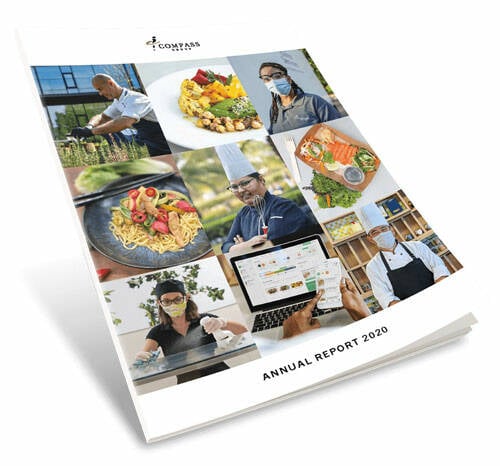
“Although COVID-19 has not changed our business model, we are evolving our strategy to increase our resilience and strengthen our competitive advantages,” Compass writes in its 2020 report. The Brits formulate three focus areas. The first one is digital: “Consumer facing use of apps and kiosks to pre-order, pre-pay, click and collect as well as back of house apps for labour management and food procurement.” Second is labour: “Increase labour flexibility, leverage our scale and pool the workforce across sectors to better accommodate volume volatility on site.” Third comes central production units: “Hubs for development, training and production to rationalise labour costs and reduce food waste.”
The belief in growth is there to stay: “The food services market (contract catering) remains very attractive. We estimate it is around $303 billion, with about two thirds currently operated by small regional players or operated in house. This means there is a significant structural growth opportunity from first time outsourcing as well as share gains.”
This year Compass Group took over EAT Club. The Californian company offers individually ordered and packaged meals to be delivered in one order for companies without their own restaurants. Companies such as Postmates are clients of EAT Club. As a part of its own Digital Labs, Compass Group can implement the high profile EAT Club platform for corporate partners in other markets. Talking about technology, Medirest, Compass’ healthcare division, introduced cleaning robots in several hospitals in the United Kingdom.
Compass Group: Evolving to digital, labour, production hubs
Yes, big challenges lie ahead for the specialists in managed foodservices and contract catering. Overlooking the initiatives of the big three, it looks like technology and food delivery are the magic words to deal with them.


5 min
Challenges and priorities of company caterers
Insights of Sodexo, Aramark and Compass Group
Ubel Zuiderveld Xiao Er Kong
Last year three big contract caterers lost $13.2 billion of their 2019 revenues. Sodexo, Aramark and Compass Group normally feed hundreds of millions of people at work worldwide every day. How are they dealing with the challenging new era that lies ahead?
When talking with top executives in the contract catering business shortly after the first COVID lockdown was proclaimed, you could feel how some were working through how to stay flexible with the needs to stay current and competitive. Working in a cost based industry with narrow margins, many of them pondered how to create a positive future. A future with more people working from home, resulting in fewer employees in office but still an opportunity to serve the industry and pivot to address new forming needs.
Sodexo: Priority on health and wellness
Sodexo posted $22.8 billion worldwide sales last year, $3 billion less than in 2019. This means the French company is back on the level of 2015. The company that Pierre Bellon founded in 1966 as a successor to the ‘Société d'exploitations hôtelières, aériennes, maritimes et terrestres’ serves 100,000 million people a day in 64 countries, and has 420,000 employees.
In Sodexos 2020-report it says: “The shock wave from the global health crisis has accelerated Sodexo’s transformation. The COVID-19 crisis strongly impacted the foodservices activity in many segments and accelerated certain consumption trends.” Sodexo says it will respond to societal forces such as changing consumption choices or resource scarcity. Sodexo will invest “in employee development and ensuring a safe, diverse and inclusive working environment that improves quality of life and fosters professional growth.” Furthermore: “Sodexo plays a critical role in the fight against obesity and malnutrition and provides solutions to make health and wellness a priority.”
Recent initiatives to better connect with the new era, are ones like teaming up with partners like Just Eat Takeaway (ordering meals online with Sodexo card), Uber Eats and HelloFresh (meal boxes with fresh ingrediënts for students). Furthermore Sodexo acquired the San Francisco company Nourish Inc. which prepares fresh meals in a central kitchen under fifteen branded station concepts. Through its own app, people at work, schools or wherever can order what they prefer. Nourish’s mission: “For us, food is medicine. Food is theater. Food is fun! We run on-time and on-budget. We set the table for your teams to eat together, supporting deeper relationships and heightened collaboration. We succeed by ensuring that your employees love coming to work.”

Aramark: Wants to enrich and nourish lives
$16.2 billion was Aramark’s global revenue in 2019. $12.8 it was last year, so $3.4 billion, 21% less. We have to go back to 2010 for such a low turnover for the American company. Aramark was founded in 1936 by two brothers. Davre Davidson started selling peanuts out of an old Dodge in Los Angeles in 1932. Together with his brother Henry, four years later they provided vending services for workers in the aviation industry in California. Nowadays Aramark manages 160,000 ‘refreshment service locations’, which serve 2 billion meals each year and more than 1 million cups of coffee.
Aramark's 2025 sustainability plan ‘Be Well. Do Well’ is, in the company’s own words, focused on positively impacting people and the planet for generations to come. “This includes eight priorities, which align with the Sustainable Development Goals set by the United Nations: zero hunger; good health and well-being; decent work and economic growth; reduced inequality; responsible consumption and production; climate change action; protection of ocean life; and reduced carbon footprint.” Mission and values: “Each of us must consider what we can do to have an enriching and nourishing impact on people’s lives every day and everywhere. The following values personify how we conduct ourselves: Sell and Serve with Passion; Front Line First; Set Goals. Act. Win; Integrity and Respect Always. Aramark delivers experiences that enrich and nourish lives.”
Aramark, which is a big player in the American healthcare segment, recently acquired Next Level Hospitality from New Jersey, a provider of culinary and environmental services to skilled nursing and rehabilitation facilities at hundreds of locations. Next Level Hospitality last year had revenues of $160 million. Within Aramark it will keep its own position. Furthermore Aramark invests in technology. Such as: the Mashgin self-checkout and pay module; the contactless and automated retail annex app store concept Quick Eats (camera and sensor based); and the so-called Good Uncle app for on-demand food delivery.

Last year the British Compass Group achieved about the same turnover as in 2016. The score of the last two years: $34.3 billion in 2019 against $27.5 billion in 2020, a drop of $6.8 billion. The distant predecessor of Compass Group was the 1941 founded Factory Canteens Limited. Later renamed to Bateman Catering, the company became a part of the food compant Grand Metropolitan. In 1987 Compass Group was formed as we know it today. The company operates in 45 countries on 55,000 locations and serves an astonishing 5.5 billion meals, close to serving one meal per year for the total world population.
“Although COVID-19 has not changed our business model, we are evolving our strategy to increase our resilience and strengthen our competitive advantages,” Compass writes in its 2020 report. The Brits formulate three focus areas. The first one is digital: “Consumer facing use of apps and kiosks to pre-order, pre-pay, click and collect as well as back of house apps for labour management and food procurement.” Second is labour: “Increase labour flexibility, leverage our scale and pool the workforce across sectors to better accommodate volume volatility on site.” Third comes central production units: “Hubs for development, training and production to rationalise labour costs and reduce food waste.”
The belief in growth is there to stay: “The food services market (contract catering) remains very attractive. We estimate it is around $303 billion, with about two thirds currently operated by small regional players or operated in house. This means there is a significant structural growth opportunity from first time outsourcing as well as share gains.”
This year Compass Group took over EAT Club. The Californian company offers individually ordered and packaged meals to be delivered in one order for companies without their own restaurants. Companies such as Postmates are clients of EAT Club. As a part of its own Digital Labs, Compass Group can implement the high profile EAT Club platform for corporate partners in other markets. Talking about technology, Medirest, Compass’ healthcare division, introduced cleaning robots in several hospitals in the United Kingdom.
Compass Group: Evolving to digital, labour, production hubs
Yes, big challenges lie ahead for the specialists in managed foodservices and contract catering. Overlooking the initiatives of the big three, it looks like technology and food delivery are the magic words to deal with them.


